
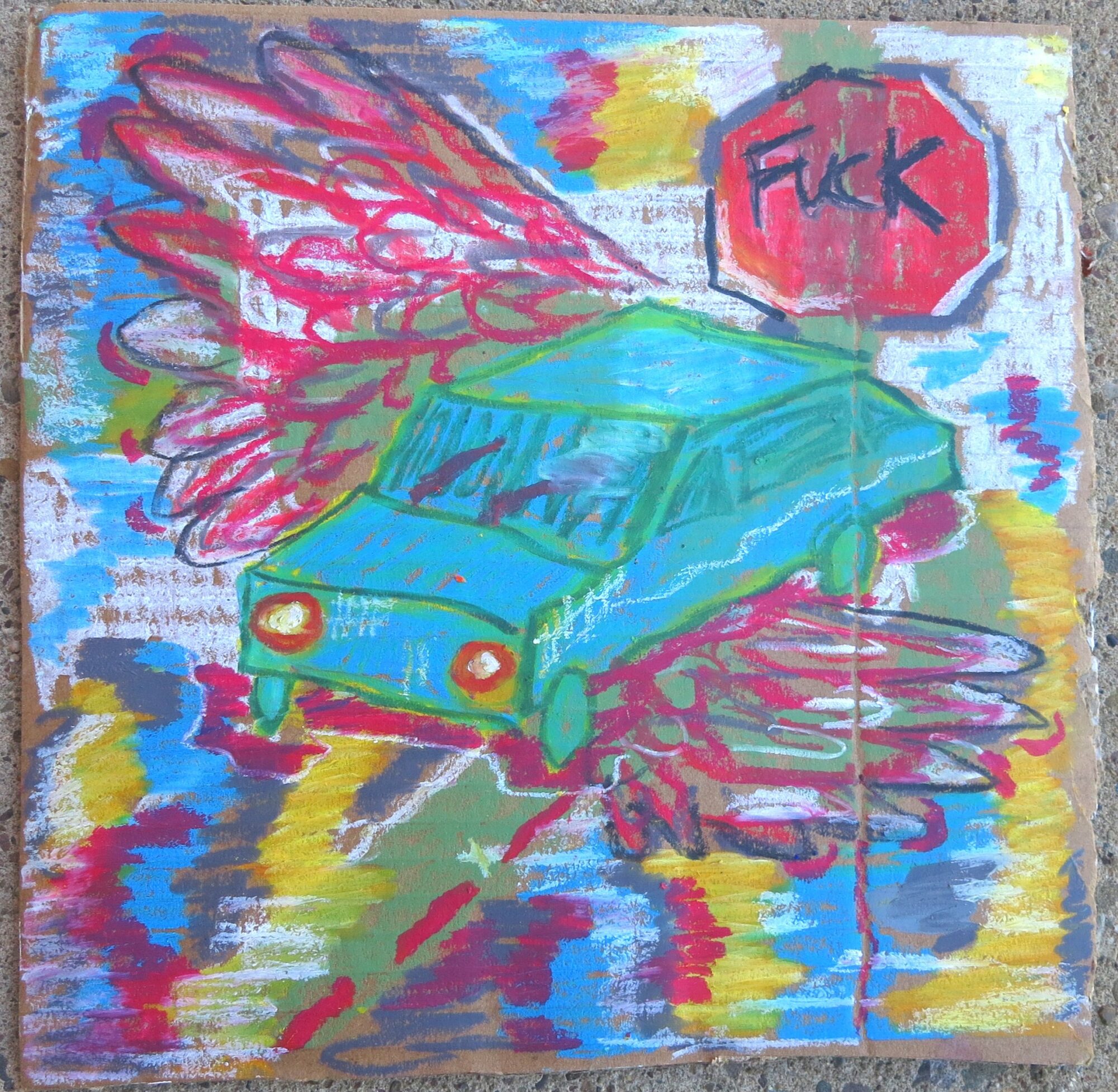
we tell ourselves stories (EP)
logan davila-sanabria
SIDE 1
45 RPM
STEREO
2715
Fragments
There are fragments of art everywhere. All we do as artists is nicely organize those fragments we’ve picked up. If we’re lucky, the shards of our work will be organized into something new by someone else, and maybe even mean something to someone. There are the obvious things of course: paintings, music, a beautiful landscape, intense emotions, the pull of the moon on the ocean. But there’s also art in our daily routines, our least favorite beverages, or a conversation overheard between strangers. One conversation with a friend can scatter its pieces in our work for years. A comparison they used might end up at the center of an essay. Their specific way of phrasing things colors dialogue in a fiction piece, and the way they were sitting at the time decides the composition of a drawing. The magic of art is the ability it has to take a single, specific memory and turn it into pieces to be transformed and expanded.
I do a lot of collecting. My room is a magpie nest of books, music, and video games that I can pull influence from. My phone is full of photographs from walks I take and stray notes when a thought feels worth writing. There are nearly full sketchbooks in my desk drawers and an empty one in my backpack. I have a bunch of tabs of vaguely relevant information to pull into my work at some point, remembering previous projects with old Google searches. I have empty Word documents with single sentence concepts I don’t know what to do with. Spotify is usually open, if not playing. I keep myself surrounded by pieces on the off chance that I get an idea of how to put them together, hoping that as I squeeze another CD onto my desk, the other pieces will fall into place.
There’s a little bookstore in town full of fragments of art, run by an old man named Homer. He sells his books for the cheapest I’ve ever seen, the walls are decorated with pictures and keepsakes from people that have come into the store over the years, and he always has a story to tell. Most weekends I come to his store with a dollar and leave with one or two books that catch my eye. This weekend, I have a bit more, so I might grab one of his Vonneguts, or maybe see if he has a nice copy of Dracula. I find my book and go up to the counter. I tell him I listened to the Bob Dylan cassette he gave me, and in return, he gives me a list of bands he thinks I’d like. Quicksilver Messenger Service, Jefferson Airplane, Buffalo Springfield, The Doors, The Byrds, all situated somewhere in the ecosystem of folk and psychedelia. I take them down in a note in my phone. He asks how school is going, and reminisces on his time at Susquehanna, telling me a story about he and a friend of his taking acid and going out into the woods, and just climbing way up into a tree, tripping out of their minds. I don’t write the story down, but it sticks with me. I buy Dracula and grab one of the buttercream mints from the basket, waving goodbye before beginning my walk back to Smith. When I get back to my room I find each band’s best-known album and add each of them to my Spotify library.
My other favorite way to collect pieces is going on walks. When I’m really truly stuck, I take a cigarette or a Monster Energy down to Softwater, and pace around the picnic tables with the notes app open and music playing. Sometimes I’ll simply take down my actions, a prose photograph to supplement the visual photos. I’ve listened to entire albums down there, written whole pieces. The run-down buildings behind me and the highway across the creek alongside the smooth water and swaying trees are my most frequent collaborators. It’s my little idea spot, and a fragment that colors a lot of my work. I can see the memories I have there, of putting fireball in a slushie, of soft guitar floating over the river in early fall, of cold night walks and stormy afternoons. All wrapped up in this one place, all seeping into my art.
When it’s time to make art, I spread the pieces I’ve collected on the floor and move them around until they look nice. Start on one Word document, find a piece of something else and go arrange that instead. Take a look at one of the records in my collection to see the average number of songs per side. Google the title of the final episode of Evangelion. Back to the first Word document and mockup a title card for it. Keep bouncing around like that until I can see the paper I’m writing in my mind. Then sit down and chip away at it until what I want lands on the page. Delete everything because it’s wrong and try again four times until it’s finally right. Now I’m moving, there’s momentum to my writing. Move things around, they’re in the wrong order. But when I’m done, the pieces I’ve collected look whole, like this was always the way they were configured. Organized chaos.
Industrial Output, Financial Imbalance, The Watusi, The Twist, El Dorado
I first listened to the Beatles’ self-titled album during my freshman winter. It was the first full Beatles album I’d listened to and it’s still my favorite to this day. There are so many ideas present and every single song is doing something interesting. My friend is obsessed with the Beatles, and when I talk to her about it now, she’s not sure what she was thinking in suggesting I start with the White Album. I happen to think that it was the only way to get me into the band. Showing me their messiest, their most eclectic. Not something technically impressive like Abbey Road or Sgt. Pepper, not something nice and clean like Rubber Soul or Let It Be. It had to be the White Album.
“Ob-La-Di, Ob-La-Da” didn’t exactly grab me on a first listen, but over time it’s grown on me, and I find the story of its production compelling. It was recorded a number of times, with Paul McCartney needing it to perfect, and the other Beatles quickly growing tired of it. By the end of it everybody was unhappy, and nobody liked the song except McCartney. And after all the strife his perfectionism caused, McCartney went with a mistake because he liked it better. The impact the recording of this song left on the group was so distinct that during the ‘Get Back’ sessions, John Lennon uses the first verse of “Ob-La-Di, Ob-La-Da” almost as a shorthand for “we’re getting sick of rehearsing this over and over.”
But if you ignore the stress it caused, it’s fascinating. So many versions of this song were recorded, and yet only one of them was good enough to press. And it included a mistake. There are so many near identical songs that could have been “Ob-La-Di” but only four ever saw the light of day, and only one we consider the “real” song. It’s a process of fitting the pieces together and finding they don’t quite click. I’m struck by the way the final song is the result of all previous and subsequent takes, informed by them, chosen over them, made of them. Mixing up Desmond and Molly’s names at the end of the song changed it, made the image complete. The whole album is like that, meticulously crafted and strange and fragmented, the cause of strife between the band, but beautiful in spite of and because of it.
“Revolution 9,” the second to last track on the album, is, in my opinion, a thesis statement for the album. It’s a sound collage made up of a few distinct types of sound clip. First, and most obvious, is someone saying, “number nine,” pulled from the studio archive. This single sound clip is repeated throughout the “song,” serving as its chorus, a random person’s document of a studio test turned timeless, central, definitive. The second type are recordings of Lennon and people he knew, the other Beatles, George Martin, Yoko Ono, et cetera, rambling and speaking nonsense, removed from context and transformed. The third type are clips presumably taken from news, radio, or television. Then there is, of course, the eerie music pervading the piece, the piano, the strings, woodwinds, sometimes reversed, mixing and clashing with each other and the other sound clips to create a feeling of unease and overwhelm the listener. And finally, there are pieces of earlier takes of the song “Revolution.” All these clips are mixed together and stripped of context to create something new, and I think in doing so reveals the nature of every song before. “Revolution 9” is a piece of art that shows the audience the pieces it’s made of, taking the discarded remnants that could have been “Revolution” and fitting them in with other pieces Lennon had scavenged. It draws attention to how art is made and the fact that art is made, not something that springs from the ether. In some ways, it’s the same as “Ob-La-Di, Ob-La-Da.” The result of repeated rehearsal, overdubbing, and a strong vision. The only difference is that “Ob-La-Di” hides its hand. “Revolution 9” does not.
The Beatles as an album might seem ironically named. At the time of recording, the Beatles as a band were at their least unified. Only sixteen of the 30 songs on the album feature all four Beatles playing. So much of the work on the album was done asynchronously, through isolated practices and overdubs. You can see the cracks where the pieces fit together, and you can see the strain where the band members have stopped fitting together. It is my favorite studio album by the Beatles. It is beautiful. And it is “Revolution 9.” It is tongue-in-cheek next to soft and sweet next to harsh and heavy, sick and beautiful, stupid and shocking. It’s a sound collage two songs away from a celebration of delicious desserts. It is a distillation of everything the band has been. It is The Beatles.
Painter of Modern Life
I am generally prone to making up stories about people. Seeing how they look, talk, and act, and imagining who they might be based on that. Getting into creative nonfiction made that habit so much worse. I am on the train on the way to visit my girlfriend, sitting alone behind two people. I’ve forgotten my headphones so I am left hoping nobody is so loud that I cannot ignore them. I crack open the manga I have just bought and begin to read. I’m barely four pages in when the people in front of me start talking. They have just come from a play I don’t remember the name of. The woman talks about some element of the plot that deals with gender – I can’t remember what, but it was along the lines of an ambiguously presenting nonbinary character. The man sitting with her cuts in with a “I think what they meant was…” and essentially repeats what she had just said to him. He does this several more times over the course of about fifteen minutes. I text my girlfriend that I am sitting behind “the CEO of Mansplaining.” That is this man’s discernible trait so far, that and the fact that he saw this play. With those facts I could imagine the rest of him. Confidently wrong and obnoxious, not an outright misogynist but often tramples people in his life without looking. I cannot tell how old he is, but if he’s in college this is his peak; if he’s older than that, he peaked in college. I do not get much from the girl, other than the fact that she, along with the man beside her, does not know much about trans folk. Eventually their conversation dies down, and I return to my manga. I can hear shreds of other conversations, the sound of the train, the flipping of pages.
I get about twenty minutes of quiet before the people in front of me begin talking again. I try to ignore them, try to continue reading. The girl is talking about her recent hookups. She talks about weird guys on dating apps, and the man she is traveling with responds in a way that feels to me like pandering. He wants her to think he’s not like those hookups. He wants her to think he’s there for her. They go on for a moment about weird men. This is finally something to go on. The girl seems confident, and in charge of her sexuality, but a little all over the place. Not great at taking care of her mental health. The guy does not have the unearned confidence I had assumed. He’s generally pretty insecure, but likes to show that he knows things. He’s also in love with the girl next to him. I don’t think either of them know it.
Something gets them on the topic of the friend they are going to visit, and I discover that they knew each other in college. They weren’t in the same friend group, but their groups overlapped a lot. Went to each other’s group functions and things like that. The girl brings up a hookup with one of the guy’s friends, and said he made some excuse for why he performed poorly. Something like “it was cold” or “I was too drunk” or some similarly unprovable excuse. The guy in his usual pandering fashion says, “Oh yeah, we all say that, it’s a good excuse.” The girl responds with “Well, you were good.” This surprises the man, and he laughs a bit. She reassures him that he was good and expresses her own anxieties that she’d performed poorly since they never hooked up again. He dispels that worry and replies, “I thought I was bad because we never talked about it.”
I am pretty much resolved to write about them. They go on to reminisce about the night they hooked up, and, more interestingly, what led up to it. The girl likes to flirt – she says it “gets her high, flirting and not knowing.” From the start of college, she was flirting with the guy. For most of that time he had a girlfriend, which just made him more interesting to her. She could flirt without worrying about anything coming of it. And it made it so he could flirt back and it would be taken as jokes. He was the only one that flirted back with as much enthusiasm as the girl. Somewhere in the years-long flirtation it stopped being just jokes. Both of them wound up attracted to each other. It didn’t matter because he still had a girlfriend. In their senior year he finally broke up with her, and later that year he and the girl hooked up. It was good sex judging by the way they talked about it, and both of them wanted to see each other again. They didn’t necessarily want a relationship, but they definitely wanted something more than friendship. Neither of them said any of this at the time. They are unpacking five years or more of emotions for the first time on this train, with an audience of one by way of forgotten headphones.
I cannot help but write about them. In observing this single moment of their lives there is so much that resonates with me. The missed connection coming to light years later puts an ache in my stomach. The way the whole conversation slowly slants towards that revelation, the fact that I will never and should never know what happened once they got off of the train, it all draws me in despite myself. This is perhaps the most directly they will ever appear in my writing, but pieces of that conversation will make it into my fiction. These people do not know I overheard them. I doubt they would be happy if they did know. But their conversation stuck with me. And in turning it to art, it may stick with others.
SIDE 2
45 RPM
STEREO
3133
Illness
(1. Complex Female Characters/ 2. What Plays Are Like/ 3. The Moon)
1. Complex Female Characters
Right now, it is 12:30 a.m. on August 29th, the fourth day of my first week of my third year of college. I have a class at 10, but I’ve given up on sleep. My brain is racing, and I have to get my thoughts out onto paper. I have just finished listening to Life by The Cardigans at the indirect recommendation of a dear friend and left my room with my laptop and a bottle of water. I’m heading down to the basement where I spent so much time last year, a sense of inspiration and a feeling of illness gripping me in a way they really haven’t in a long time. When I get down there, I realize my water bottle is empty and go to refill it back upstairs. “Lovefool” has started auto-playing on Spotify. The song makes me unwell. I refill my water bottle and head back to the basement. I take my computer out of my backpack, out of its case, and plug it in before setting up a game of pool for whenever my thinking hits a lull. The song ends, and I put on a playlist. Then I sit down at the table next to the vending machine, which has been moved since last year, and begin writing.
This burst of inspiration I am having was sparked by rereading an essay I was introduced to by a friend in my freshman year. The essay is called “standing on the shoulders of complex female characters,” and it was written by Rayne Fisher-Quann. It was published on February 6th of 2022 to Fisher-Quann’s Substack. The essay talks about the ways Fisher-Quann has taken to not only romanticizing her suffering, but changing her actions so that she suffers romantically. She describes the way a lot of girls package and sell their suffering, describing themselves as a list of aesthetic signifiers. For example, she talks about girls who are “self-described joan didion/eve babitz/marlboro reds/straight-cut levis/fleabag” girls. A collection of art, artists, and products that Fisher-Quann says lets girls signify they have depression. She also describes the ways she has shaped her life to create art for an audience. She puts on eyeliner if she knows she will cry, she eats dark chocolate during her depressive episodes, and she looks to art for the blueprint of how to suffer like a “hot girl.” She talks about the comfort she receives from living in a way that people understand. That she acts in a certain way and people can understand she is depressed, that she can tell people she’s “in her fleabag era” and they know what she means. She wonders how much of her experience is shaped by art and aesthetic signifiers. She is disturbed by the idea that she lives and sees the world through the lens of being consumable.
The essay is hauntingly resonant. It makes me ill, one of the best things art can do. The particular phrasing of “ill” or “unwell” is a fragment I picked up from my friend. Art that makes me ill does this by resonating with a part of me that is unhealthy, unpleasant, unwanted, or otherwise uncomfortable. “standing on the shoulders of complex female characters” is permanently seared into my brain. Its final line in particular floats through my mind so often it’s like a friend to me: “i had to give up journaling because i couldn’t stop writing for the people who would read it after i was dead.” That single line is so beautiful and sickly, both a perfect conclusion to the essay and a perfect illustration of the very problem it is pointing at. That line has taken Fisher-Quann’s suffering and turned it into something beautiful and romantic. Still deeply unwell, but beautiful. The essay put words to a feeling I’d been grappling with for years. It was itself a piece of art through which I could feel understood. At many of my lowest moments, my notes app is open. I know I can turn my awful nights into something beautiful. Maybe that’s why I took so strongly to creative nonfiction. I take walks at night, put on music that puts pits in my stomach, write essays at midnight and drink monster energy, I drink too much coffee and spend all day lying in bed in a room I’ve neglected for weeks, with a full bottle of pills that are supposed to help under my bed. I read Joan Didion and Eve Babitz, smoke the odd cigarette, eat dark chocolate, and have watched all of Fleabag three times. I wrote terrible stories in middle school about young feminine boys who felt alienated, dragging my experiences onto the page. I made a short film for my high school film class about the awful stress school was putting on me. My first and only workshop submission for Intro to Creative Nonfiction was a dragging, disoriented walk through a difficult, albeit manageable depressive episode. I write down every pretty, ugly, sad thought I have. It’s second nature. Turning my suffering into something beautiful. My illness into art.
When my friend first read me this essay, we were sitting on a bench by Bogar, watching the leaves fall. It was just past midnight in late October of my freshman year. I’d had a rough day and couldn’t take a large group hangout, so I texted them and asked to go on a walk. We walked for a bit. I was in the process of falling in love with them at the time. I talked about feeling bad, my seasonal depression, and how I was trying to deal with it. Then we sat, arms around each other, watching the leaves. And then they got a text I think, a link from a friend they were in love with. They read me Fisher-Quann’s essay, and it made both of us feel ill. And we sat watching the leaves for a while longer.
2. What Plays Are Like
This past summer, I read a short story called “You Want to Know What Plays Are Like?” by Raphael Bob-Waksberg. It is about a woman, Dakota, going to see a play written by her brother, Dusty. His play happens to focus on fictionalized versions of himself, Dakota, and their dead sister Shannon. Dakota is hurt by the play. From her point of view, it makes her out to be an asshole, it disrespects their sister, and it airs out dirty laundry that is not solely Dusty’s to air. She confronts Dusty after the play, and he responds with his own hurt, and with confusion. Dakota says their dead sister was off limits. Dusty responds, “When you’re an artist, it’s all grist for the mill.” It’s this awful, hollowing pain on behalf of the artist’s subject, and in its negative space is a rotting guilt on the author’s part. It is the fear of that guilt that keeps me frozen.
That is the downside to turning my life and problems into art. A story that deals with more than my own depressed isolation, that calls for more characters than my self and my bed is, by my estimation, a dangerous creature. I can tell by the tightness of my muscles on my bones and the cold pressing feeling in my lungs that creating art from my friends and loved ones is something that can tear my throat out. There is a distance at which I’m comfortable turning people into art. I do not think Paul McCartney gives a damn that “Ob-La-Di, Ob-La-Da,” informed one of my essays. I am not worried about what Rayne Fisher-Quan thinks of how her essay affected me. The two people I sat behind once on a train do not frighten me. I do not know their faces, so I could not confirm it is about them even if they recognize themselves. Those accounts are safely behind glass, unable to reach me. If I can look them in the eye, I must be ready to run. If I can hear their breath I am in danger.
Somewhere between Paul McCartney and my close friends and family was my creative nonfiction class. I know most people in the class well enough to give them a polite nod at best, and yet I know their families, friends, their grief, their childhoods, the things that make them ill, their odd habits and fixations, their low moments and their joy. Worse still, some of these pieces of their hearts, pieces that they submitted for a grade, have become embedded in me. I think differently about the things people throw away, and I feel ill when I think about Helena from A Midsummer Night’s Dream, and that’s only the effects of one person’s writing. They live just downstairs from me, and I’ve only talked to them once this semester. They’ll be resonating in my art for a long time. If I am thinking about limerence and all the awful sickly feelings therein, it is attached to that person. “I learned a new word today and it is fucking with my head.” Now they will know without question that I am writing about them. That’s terrifying.
It’s a lot harder when my problems intersect with people I see in my everyday life. In my compulsion to turn my pain and sickness into something beautiful, I am drawn to making art about friends and love and the soft feverish overlap between them. The quiet things whispered late at night, the tear-soaked sweaters, electric kisses, soft music and silence are drawn to the page like salmon to their spawning ground, swimming up a stream of guilty anxieties. If I turn people into art, I am left guessing whether they know it is them, trying to read from their eyes and voice whether I have done them wrong in writing them, whether I have overstepped or misspoken, how I come off. Whether I have written like I am in love with them or, just as bad, like I do not love them. If my writing this moment drudged up feelings for them, reminded them of things they would rather forget, if I have been unfair to them in using the fragments they gave me. I have no way to know. I do not want to know. So, I stay paralyzed. I can’t articulate how scary it is to look someone in the eye and know that they know a piece I wrote is about them. But I can’t help but accumulate fragments. Conversations stick with me forever, and small moments of anxiety, depression, magnetism, care and being cared for litter my notes app. And I cannot help but turn them into something.
It is one thing to see yourself in a piece of art in a relational sense. To look at a piece someone grabbed from their life and recognize yourself in it the way you might recognize animals in the clouds. That piece is not you, but you can see yourself in it. It is another thing entirely to see your self in a piece of art. To look up at the person on stage and go “Shit. That’s me. They made that from me.” Art deals in people’s hearts. It is a shock to see yours outside your body. It is the most naked I have ever felt.
3. The Moon
The moon is behind the clouds, leaving the sky lopsided. It is far too late for coffee. Take the grinder, espresso cup, and greca to the kitchen. Fill the bottom with water, then the middle compartment with the coffee you ground yesterday. Put it on the stove, remembering to put the burner down to five, hoping to avoid burning today’s cup. Sit there waiting, listening to TV Girl until the coffee begins to perk. You’ve made too much coffee, but it does not matter.
Fragments of art are often passed from person to person, changed in the process of transfer, but traceable if you know what you’re looking for. Often this is on a broader scale. You can trace Tatsuki Fujimoto’s Chainsaw Man back to Devilman and FLCL and understand how those pieces got there. You can trace those works back to their origins, and follow those fragments back like an evolutionary line that ends in Chainsaw Man. You can trace this essay back to other works too; I can tell you the pieces I used and you can pick them out from the bunch. There are things here I picked up directly from individuals too. My high school English teacher, my high school film teacher, my friends, my sister, my professors. And there are pieces I carry with me that I don’t remember picking up. The things that make my bones bend like a house in a hurricane, the things that make me weightless and spinning, the things that pull smiles onto my face and the things that drag tears onto my friends’ shirts. They come from pieces that have stuck deep in my chest like bullet wounds that I have not bothered to fish the bullets out of. The pressure and heat at my core breaks them and melts them and fuses them and smooths and messes them around until I cannot tell where they come from, only that they are there, and that they are mine.
There is something beautiful in recognizing you have picked up the same fragment as someone else. Recognizing a favorite movie in a show you’re watching. Talking with someone and finding out you have the same favorite song. Discovering that the same things make the both of you ill. Having a shared experience of crippling high school anxiety. The same rough time talking to people. A shared love for the moon. An affinity for the same location. Love for the same video games. Reading a beautiful essay by an acquaintance and finding they share influences with you. It’s wonderful, if a bit frightening at times. And as you get to know people, they hand you fragments. They get you into the Beatles, or Chopin, or Chainsaw Man, or Yes, or Three 6 Mafia. You pick up a mannerism or two, they introduce you to your new favorite movie, you have a conversation that changes you as a person. You try to start a band. You listen to each other’s albums until your music tastes begin to blur. You pile eight people into one car. You have quiet conversations when the group you were supposed to hang out with have all fallen asleep. You cry. You lay down by Softwater, not speaking, and you leave repaired. You change each other, exchanging fragments of your hearts.
It is a strange experience, discovering where a piece of someone else came from. Something like finding out the name of a beautiful stranger. I picked up my appreciation for the Beatles from a friend. She picked it up from an obscure animatronic attraction. Being able to trace something so significant in my college experience to something so tangential, so obscure, is mind-bending. Similarly, I picked up “standing on the shoulders of complex female characters” from another friend. I visited them this past summer, and one night, somewhere around our third beer, after our second game of pool, they sat me down and explained to me the person they’d been in love with for years. There were three letters. In all three I found fragments I shared with this person. Some of them we’d picked up independently, coincidences making kindred spirits. A love for the moon, for example. An ache. A sense of romance and nostalgia. Some of them I imagine we’d both picked up from our friend. And some of them had been passed from this complete stranger to me through my friend. Fisher-Quann’s essay is one of them. Other small things I can’t quite place. I found pieces of my friend in the letters too, though I can’t tell from whom they originated. Chess, classical music, the violin, and that awful beautiful ache. They are in my friend’s writing, the source of floating sickly words that spin around my head like the winds above a flood. And I do not know them. In all likelihood, I never will. And we sat, arms around each other, feeling ill.
Last Monday I was texting my friend. We were talking about Ireland, and aches, and I told them I’d been “evilly nostalgic. Just weird kind of sickly blurry floating. The campus is too tied up in different times and I keep snagging on the benches and bleachers and the way the moon looks through the trees at Softwater. Had a night where I took pictures of benches I like. Weird. Not like consuming evil. Just dull and achy.”
And I told them about two essays I was working on for this album, the other two parts of “Illness.” At that point I was still working on “Strong Female Characters.” I told them I didn’t know if I’d include it in the full essay because it’s so anchored in the nostalgia blur I was feeling. They asked me to send it. I said “maybe.” Hinted at the idea of “What Plays Are Like.” Doubled down on my “maybe” because “Strong Female Characters” is too much about them. These pieces are too About Them. They told me about the beautiful people they were meeting in Ireland. A week later I sent it to them, along with “Fragments Part 1.” They said it made them ill. The next day we called on the phone, and we talked about classes and Ireland, how we were doing as well as we could be, and eventually we got around to my essay. They told me their friend had a couple essays that mine reminded them of. And they told me how things had resolved with their friend since I had seen them last. And we hung up. I sent them “You Want To Know What Plays Are Like.” They sent me their friend’s essays. And I read them. And I found that same sickly snagging nostalgia. They compare it to Lot’s wife, turned into a pillar of salt when she could not resist the temptation to look back.
I am sitting on the bench near Bogar. I have just finished reading my friend’s friend’s essay on moving out of their house, how it’s saturated with pieces of their life and self, and how it will stop being theirs. I look into my notebook at something I’d written yesterday in response to their idea of Salt Pillaring, and I just sat there, the moon looking over my shoulder at the different pieces that fit together into similar shapes. Like this was the way they had always been configured. Pure Chaos.
logan davila-sanabria
LoganDavila-Sanabriais a Junior English Literature Major at Susquehanna University. They are treasurer of the SU Shakespeare Club, and a member of ALAS and the Black Student Union. They are from New Haven, Connecticut, where they live with their parents and sister.
- This author does not have any more posts.